I conducted a class the other day "Wow!That's PowerPoint:Avoiding Death by PowerPoint" and told the attendees I would post some helpful resources on my blog so here are the resources. Some are free and some for fee.
Here are some resources that can be of assistance.
Books:
So, Interactivity by Design is an older book and not specifically geared toward a slide show (it is focused on designing visually appealing e-learning). But it is well written with wonderful examples. I strongly recommend it if you are creating PowerPoint, Keynote or e-learning presentations/training.
Links:
Garr Reynolds Top Ten Slide Tips
Four Ways to Improve a Presentation
How Cognitive Science Can Improve Your PowerPoint Presentation
Presentations:
Convert Bullets to SmartArt in PowerPoint 2007
Avoiding Death by PowerPoint
And a new series I am starting called Wow!That Presentation was Awesome!(This is for fee, $50. The first three slides are teaser but contain valuable information and then you hit the "toll booth.")
For Some Examples:
Go over to Slide Share and search for "worlds best presentation" examples.
__
Catalog of Recommended Books, Games and Gadgets
Recommended Games and Gadgets
Recommended Books
Content Guide
Friday, September 18, 2009


Wednesday, September 16, 2009
Mini-Course Project
Working on a number of projects (including the newest book) but am also creating a mini-course with my good friends at Kaplan EduNeering. I've written a number of whitepapers and done a number of projects with their Chief Learning Officer and now she and I have teamed up with the folks from the 8:45 Club to create a course which is broken into 10 segments and delivered to your desk top every morning to start your day.
The idea is that you can get up and start to learn at 8:45 and then be done by 9:00, I love the concept of the mini-course. Starting the day with a short learning event is a great way to get going. We are doing our course on Designing instruction, with an overview and then a deeper dive into the ADDIE model of instructional design.
Here is a smuggled screen shot of part of the course. Look for an announcement soon at this blog of how you can register for the course at Kaplan EduNeering and start your day with a mini-lesson on instructional design.

Karl discussing the ADDIE model of instructional design in less than 15 minutes.
__
Catalog of Recommended Books, Games and Gadgets
Recommended Games and Gadgets
Recommended Books
Content Guide
The idea is that you can get up and start to learn at 8:45 and then be done by 9:00, I love the concept of the mini-course. Starting the day with a short learning event is a great way to get going. We are doing our course on Designing instruction, with an overview and then a deeper dive into the ADDIE model of instructional design.
Here is a smuggled screen shot of part of the course. Look for an announcement soon at this blog of how you can register for the course at Kaplan EduNeering and start your day with a mini-lesson on instructional design.

__
Catalog of Recommended Books, Games and Gadgets
Recommended Games and Gadgets
Recommended Books
Content Guide
Monday, September 14, 2009
I Want My MTV--Virtual MTV

So I was around and in the "prime music age" (read teen) when MTV launched. I remember staying up all night to watch awesome music videos. We thought it was just awesome. And now in its alpha version you can check out a "sorta" 3D virtual MTV as the station moves to create an online venue for fans of the cable network to hangout when they are not watching music videos.

You can do a bunch of neat things, including visiting a lounge, a design studio and decking out your crib. Perhaps this virtual world is set to give Second Life a run for its money. Check out the alpha version of Virtual MTV.
However, with the financial crisis still clearly upon us, shouldn't that age group be hanging out in a more financially educational venue like Stage Coach Island?
__
Catalog of Recommended Books, Games and Gadgets
Recommended Games and Gadgets
Recommended Books
Content Guide
Friday, September 11, 2009
Common Craft, Quick Educational Videos for Sale
I've always enjoyed Common Craft videos and as of a few months ago, they've created a new business model in which educators (and others) can purchase a high quality versions of the videos and either post them on the web or download for use in classroom or training room.
Seems like a great business model for making quick, short but educational videos available to explain complicated or difficult concepts and to set expectations for a training session. Great use of simple media to get across complex ideas.
Here are two samples explaining the increasingly popular Twitter (these are the free versions available on YouTube). The ones that are available for purchase have no advertising - The free versions often have advertising, the Common Craft watermark and promotional sections. Additionally, the downloadable versions are of a higher quality.
So check these out and see if a Common Craft video might be something you want to add to your training toolkit.
__
Catalog of Recommended Books, Games and Gadgets
Recommended Games and Gadgets
Recommended Books
Content Guide
Seems like a great business model for making quick, short but educational videos available to explain complicated or difficult concepts and to set expectations for a training session. Great use of simple media to get across complex ideas.
Here are two samples explaining the increasingly popular Twitter (these are the free versions available on YouTube). The ones that are available for purchase have no advertising - The free versions often have advertising, the Common Craft watermark and promotional sections. Additionally, the downloadable versions are of a higher quality.
So check these out and see if a Common Craft video might be something you want to add to your training toolkit.
__
Catalog of Recommended Books, Games and Gadgets
Recommended Games and Gadgets
Recommended Books
Content Guide
Thursday, September 10, 2009
Virtual Learning Possiblities

If you want to find out some possibilities of virtual worlds for interactive learning, check out the introductory video by Virtual Learning Curve. It gives a good overview of some of the possibilities of Virtual Immersive Environments (VIEs).
For even more interesting and engaging videos go to the Scenes to Watch and checkout some samples and trailers that really point to the power of 3D virtual environments.
Check out the company at Virtual Learning Curve.
__
Catalog of Recommended Books, Games and Gadgets
Recommended Games and Gadgets
Recommended Books
Content Guide
Wednesday, September 09, 2009
Learning in 3D Available for Pre-Orders
Well, even as I secure the last of permissions and put the finishing touches on the accompanying instructor guide, Learning in 3D can now be pre-ordered.
So, if you want to be one of the first to read the book that Tony O'Driscoll and I have put together on the subject, check the link below:
You can read about the book and its contents at Tony's entry about the book, Learning in 3D Book is DONE!
Or if you want the publisher's page and a great discount on Gadgets, Games and Gizmos and Learning in 3D visit the publishers web page.
PS: If you go to Amazon, click on the Link "Tell the Publisher you want to read this book on a Kindle" because that'd be an awesome platform for just this kind of book!
__
Catalog of Recommended Books, Games and Gadgets
Recommended Games and Gadgets
Recommended Books
Content Guide
So, if you want to be one of the first to read the book that Tony O'Driscoll and I have put together on the subject, check the link below:
You can read about the book and its contents at Tony's entry about the book, Learning in 3D Book is DONE!
Or if you want the publisher's page and a great discount on Gadgets, Games and Gizmos and Learning in 3D visit the publishers web page.
PS: If you go to Amazon, click on the Link "Tell the Publisher you want to read this book on a Kindle" because that'd be an awesome platform for just this kind of book!
__
Catalog of Recommended Books, Games and Gadgets
Recommended Games and Gadgets
Recommended Books
Content Guide
Tuesday, September 08, 2009
Teach Students to Teach--So they become better learners

Are students the only ones who ever learn in the classroom? Most teachers will say that they didn’t really know the material until they teach it. Therefore, instructors, trainers and teachers should encourage a "Teaching to Learn" atmosphere in their virtual or face-to-face classrooms.
This method asks learners to teach what they are learning to each other. Therefore, it is critical to the success of each learner that he or she not only go through course content, but also really think about how to teach the material to his or her colleagues. The most challenging aspect of this approach is that the learners will need to anticipate questions from their colleagues, and be prepared with answers.
This is when true learning takes root. Once a person is put in a position to have to teach and explain content to someone else, he or she will never forget it. The result will be increase retention and understanding.
Unlike traditional lecture-based training in which the facilitator teaches a group of learners by reviewing content in a monologue format, the "each one, teach one" methodology generates discussion of key points by the learners, facilitated by the trainer’s skilled use of initial and follow-up questions. The methodology assumes learners enter the training having mastered and synthesized the content, needing only clarification or refinement in their knowledge.
This instructional method or strategy sets different expectations for, and requires different skills from the trainer and the learner. The trainer is expected to keep track of the progress of the discussion, noting which key points are reviewed and to what degree of clarity and completeness. The trainer needs to be able to think on his/her feet, ready to formulate a new question or circle back to an earlier part of the discussion to reinforce a key point. The trainer must listen to what is said – and listen for what is not said.
Based on the flow of the discussion and the dynamics of the particular group of learners, the trainer needs to be ready to shift gears and change tempo to ensure all key points are addressed and less critical points do not receive an overabundance of time and attention. These skills are, of course, much different than the competency of presenting a prescribed set of information.
The "each one, teach one" method also requires a much higher level of involvement and engagement for the learner. Rather than acting as passive recipients of knowledge, This method asks learners to study and synthesize key knowledge before even showing up to the “training.” In the actual moment of “teach-back” e.g. presenting and clarifying key information to peers, learners are quickly able to identify their own level of comprehension of material.
in addition, the opportunity to participate in this way reinforces key skills and forces the learners to develop an ability to concisely and intelligently synthesize information and engage in substantive conversation within the context of how the learning will be used on the job.
Give it a try in your classroom or your training session.
__
Catalog of Recommended Books, Games and Gadgets
Recommended Games and Gadgets
Recommended Books
Content Guide
Friday, September 04, 2009
The Darkerside of Social Media and Parents? Parody
It's Friday, you've been scratching your head all week to think of how to get the boss to adopt social media. He or she isn't using it at home and doesn't see the value at work either.
Well, perhaps you are not positioning the use of social media correctly, try using the argument presented in the video below...if they have kids. This argument may convince them to join social media sites in a jiffy...and then soon they'll not only be virtually stalking their kids but their employees as well.
Facebook, Twitter Revolutionizing How Parents Stalk Their College-Aged Kids
And speaking of virtual stalking with Web 2.0 technology...you may have noticed I've added a TWEET THIS button to the bottom of my posts (Per requested comment from Rani). So, give it a try and Tweet this post.
Have a great weekend....
__
Catalog of Recommended Books, Games and Gadgets
Recommended Games and Gadgets
Recommended Books
Content Guide
Well, perhaps you are not positioning the use of social media correctly, try using the argument presented in the video below...if they have kids. This argument may convince them to join social media sites in a jiffy...and then soon they'll not only be virtually stalking their kids but their employees as well.
Facebook, Twitter Revolutionizing How Parents Stalk Their College-Aged Kids
And speaking of virtual stalking with Web 2.0 technology...you may have noticed I've added a TWEET THIS button to the bottom of my posts (Per requested comment from Rani). So, give it a try and Tweet this post.
Have a great weekend....
__
Catalog of Recommended Books, Games and Gadgets
Recommended Games and Gadgets
Recommended Books
Content Guide
Thursday, September 03, 2009
Teacher...Stepping Stone to Rock Star?
It appears that one way to become a rock star is to spend some time in the classroom honing your skills. I think teachers are rock stars anyway (several changed my life and provided inspiration without evening knowing it)...but here are a few teachers who become real rock stars (they sold out.)
Did you know that Gene Simmons taught sixth grade in Harlem before he became the world's most famous bass-playing demon.
Or that Sting taught English, music, and soccer at St. Catherine's Convent School.

Or that Art Garfunkel taught math at the Litchfield Preparatory School in Connecticut when "Bridge Over Troubled Water" soared to the top of the charts.
Check out other famous people who gave up teaching life for other careers.
This just shows the creativity, enthusiasm and "out side of the box" thinking that many teachers have. Check out School House Rock, School of Rock where I discuss the virtues of learning to play music and creativity in a school setting. Teachers are a great resource and need to be treated as such. We should all keep this in mind as out kids head back to school.
__
Catalog of Recommended Books, Games and Gadgets
Recommended Games and Gadgets
Recommended Books
Content Guide
Did you know that Gene Simmons taught sixth grade in Harlem before he became the world's most famous bass-playing demon.
Or that Sting taught English, music, and soccer at St. Catherine's Convent School.
Or that Art Garfunkel taught math at the Litchfield Preparatory School in Connecticut when "Bridge Over Troubled Water" soared to the top of the charts.
Check out other famous people who gave up teaching life for other careers.
This just shows the creativity, enthusiasm and "out side of the box" thinking that many teachers have. Check out School House Rock, School of Rock where I discuss the virtues of learning to play music and creativity in a school setting. Teachers are a great resource and need to be treated as such. We should all keep this in mind as out kids head back to school.
__
Catalog of Recommended Books, Games and Gadgets
Recommended Games and Gadgets
Recommended Books
Content Guide
Wednesday, September 02, 2009
Web Resources for Teachers

Over at the Online Degree web site, I recently was pointed to couple of interesting items.
The first is a list of 100 Essential Web 2.0 Tools for Teachers. A good list of some great web sites and technologies (for teachers and others.)
Also is a list of online universities and brief descriptions on the universities. You can also click to send for more information. I was hoping for more of a "review" as the title indicated (like, uses adjunct faculty or has full-time faculty or has both land-based classes and online)but it is still a list of online schools that you can find all in one place.
__
Catalog of Recommended Books, Games and Gadgets
Recommended Games and Gadgets
Recommended Books
Content Guide
Tuesday, September 01, 2009
Presentation Resources
Thinking of converting your Slide Presentation from drab to fab (I always wanted to write that.) Well here are some resources that can be of assistance.
So, Interactivity by Design is an older book and not specifically geared toward a slide show (it is focused on designing visually appealing e-learning). But it is well written with wonderful examples. I strongly recommend it if you are creating PowerPoint, Keynote or e-learning presentations/training.
Also, here are some great online resources;
Garr Reynolds Top Ten Slide Tips
Avoiding Death by PowerPoint
Four Ways to Improve a Presentation
How Cognitive Science Can Improve Your PowerPoint Presentation
Go over to Slide Share and search for "worlds best presentation" examples.
Here is one:
What resources do you use to improve your presentations and visual for e-learning?
__
Catalog of Recommended Books, Games and Gadgets
Recommended Games and Gadgets
Recommended Books
Content Guide
So, Interactivity by Design is an older book and not specifically geared toward a slide show (it is focused on designing visually appealing e-learning). But it is well written with wonderful examples. I strongly recommend it if you are creating PowerPoint, Keynote or e-learning presentations/training.
Also, here are some great online resources;
Garr Reynolds Top Ten Slide Tips
Avoiding Death by PowerPoint
Four Ways to Improve a Presentation
How Cognitive Science Can Improve Your PowerPoint Presentation
Go over to Slide Share and search for "worlds best presentation" examples.
Here is one:
One Hour PowerPoint: Ten Strategies for Improving Presentations
View more presentations from David Jakes.
What resources do you use to improve your presentations and visual for e-learning?
__
Catalog of Recommended Books, Games and Gadgets
Recommended Games and Gadgets
Recommended Books
Content Guide
Monday, August 31, 2009
Training Industry.com: Blogging Over There Also

It seems that I am now blogging all over the place. I now a Featured Blogger and am writing a periodic blog over at TrainingIndustry. The blog is called The Tech Dimension and will expand on idea and concepts related to integrating technology into the learning process. The first entry is called Understanding New Learning Technologies.
Stop by and check out some definitions and ideas related to Web 2.0 learning technologies. They are the fundamentals you'll need to understand Web 2.0 Learning technologies and the potential impact on learning within an organization.
So, while I am blogging at other places, know that I will continue this as my "home base" of blogging and will point you toward my other entries as appropriate.
__
Catalog of Recommended Books, Games and Gadgets
Recommended Games and Gadgets
Recommended Books
Content Guide
Thursday, August 27, 2009
TrainingDay: Back on The Blog
So, I have to admit that when I was co-writing Learning in 3D, my blogging was diminished but now that the book is 99% finished (just the permissions and instructor guide to finish), I'm back to almost regular blogging and as part of that I am again blogging at the TrainingDay blog. Here is my latest entry.
Letter to Your Boss About Virtual Immersive Environments. It contains some really interesting ideas about how to sell your boss on Virtual immersive learning environments, of course another way is to have him or her read: Learning in 3D but that won't be available until January.
__
Catalog of Recommended Books, Games and Gadgets
Recommended Games and Gadgets
Recommended Books
Content Guide
Letter to Your Boss About Virtual Immersive Environments. It contains some really interesting ideas about how to sell your boss on Virtual immersive learning environments, of course another way is to have him or her read: Learning in 3D but that won't be available until January.
__
Catalog of Recommended Books, Games and Gadgets
Recommended Games and Gadgets
Recommended Books
Content Guide
Wednesday, August 26, 2009
Student Generated Machinima
Here is another machinima done by some of my students this summer as they worked in Second Life.
__
Catalog of Recommended Books, Games and Gadgets
Recommended Games and Gadgets
Recommended Books
Content Guide
__
Catalog of Recommended Books, Games and Gadgets
Recommended Games and Gadgets
Recommended Books
Content Guide
Tuesday, August 25, 2009
How Much for that E-Learning in the Window?
One of the biggest obstacles companies encounter when looking for e-learning is the question...how much does it cost? That question has been around for ages and never seems to have a satisfactory answer. Most e-learning vendors are a little evasive when it comes to answering that question.
As a case in point, check out this posting called Does anyone know how to price e-learning?
Here is another story on the price of e-learning called The Cost of E-Learning
When it comes to LMS pricing, the answers are even less forthcoming.
Enter a vendor who is laying the pricing issue right on the table. A company called Intellum provides a wonderful pricing matrix on their site. And the matrix is visual so instead of having to wonder what a "medium level of interactivity" actually means. You can click on sample screen shots and see what you can get for $10,000 or $20,000 or even up to $40,000. The concept of open samples and pricing is wonderful for clients.
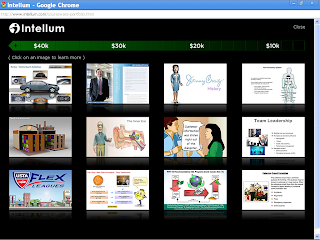
Click on image to see examples arranged by price.
They do the same for their LMS pricing structure.

You know the LMS price from the beginning.
Love the concept. Check out the site and the software, you'll have a really good idea of what you are purchasing and what you can get for your dollar...such a novel approach to custom course development and LMS pricing...amazing.
UPDATE: Here is a link from OnPoint Digital to their advertised pricing structure. They've been letting customers use an interactive Excel-based model right off their main web sites to allow customers and prospects to quickly determine the 1 to 3 year price for any solution we offer for many years. Check out a link to their pricing.
__
Catalog of Recommended Books, Games and Gadgets
Recommended Games and Gadgets
Recommended Books
Content Guide
As a case in point, check out this posting called Does anyone know how to price e-learning?
Here is another story on the price of e-learning called The Cost of E-Learning
When it comes to LMS pricing, the answers are even less forthcoming.
Enter a vendor who is laying the pricing issue right on the table. A company called Intellum provides a wonderful pricing matrix on their site. And the matrix is visual so instead of having to wonder what a "medium level of interactivity" actually means. You can click on sample screen shots and see what you can get for $10,000 or $20,000 or even up to $40,000. The concept of open samples and pricing is wonderful for clients.

They do the same for their LMS pricing structure.

Love the concept. Check out the site and the software, you'll have a really good idea of what you are purchasing and what you can get for your dollar...such a novel approach to custom course development and LMS pricing...amazing.
UPDATE: Here is a link from OnPoint Digital to their advertised pricing structure. They've been letting customers use an interactive Excel-based model right off their main web sites to allow customers and prospects to quickly determine the 1 to 3 year price for any solution we offer for many years. Check out a link to their pricing.
__
Catalog of Recommended Books, Games and Gadgets
Recommended Games and Gadgets
Recommended Books
Content Guide
Monday, August 24, 2009
Online Education: Better than the Classroom?

A recent study issued by the United States Department of Education, titled Evaluation of Evidence-Based Practices in Online Learning found that “On average, students in online learning conditions performed better than those receiving face-to-face instruction.”
The study is a study of studies (meta-analysis), meaning they looked at many studies comparing online, face-to-face and blended learning and then drew conclusions. Of course it seems to come down to the fact that well design e-learning is good sound instruction.
Here is a portion of the abstract to the paper:
A systematic search of the research literature from 1996 through July 2008 identified more than a thousand empirical studies of online learning. Analysts screened these studies to find those that (a) contrasted an online to a face-to-face condition, (b) measured student learning outcomes, (c) used a rigorous research design, and (d) provided adequate information to calculate an effect size. As a result of this screening, 51 independent effects were identified that could be subjected to meta-analysis. The meta-analysis found that, on average, students in online learning conditions performed better than those receiving face-to-face instruction.
Here are some more of the findings:
- Students who took all or part of their class online performed better, on average, than those taking the same course through traditional face-to-face instruction.
- Instruction combining online and face-to-face elements had a larger advantage relative to purely face-to-face instruction than did purely online instruction.
- Studies in which learners in the online condition spent more time on task than students in the face-to-face condition found a greater benefit for online learning.
- Most of the variations in the way in which different studies implemented online learning did not affect student learning outcomes significantly.
- The effectiveness of online learning approaches appears quite broad across different content and learner types. Online learning appeared to be an effective option for both undergraduates (mean effect of +0.35, p < .001) and for graduate students and professionals (+0.17, p < .05) in a wide range of academic and professional studies.
- Elements such as video or online quizzes do not appear to influence the amount that students learn in online classes. The research does not support the use of some frequently recommended online learning practices. Inclusion of more media in an online application does not appear to enhance learning. The practice of providing online quizzes does not seem to be more effective than other tactics such as assigning homework.
- Online learning can be enhanced by giving learners control of their interactions with media and prompting learner reflection. Studies indicate that manipulations that trigger learner activity or learner reflection and self-monitoring of understanding are effective when students pursue online learning as individuals.
However, before online learning designers can open the champagne, a few caveats from the study:
As quoted from the study:
The studies in this meta-analysis do not demonstrate that online learning is superior as a medium, In many of the studies showing an advantage for online learning, the online and classroom conditions differed in terms of time spent, curriculum and pedagogy. [Kapp's Note: Read "Instructional design was better in the online course."]
It was the combination of elements in the treatment conditions (which was likely to have included additional learning time and materials as well as additional opportunities for collaboration) that produced the observed learning advantages. At the same time, one should note that online learning is much more conducive to the expansion of learning time than is face-to-face instruction.
So it appears that the more time someone spends learning a topic and the better the DESIGN OF THE INSTRUCTION...the more learners learn...makes sense (elearning allows for the expansion of learning time which, I believe, is probably the difference in the amount of learning, not the medium itself and forces instructional design as opposed to the "winging-it" done in many classrooms.)
Students seem to spend more time actually learning or studying in online courses than in face-to-face according to this analysis of studies.
Another interesting and random-as it relates to this blog post-fact... "more than a million K–12 students took online courses in school year 2007–08." K-12 kids are taking online courses and a lot of them! This phenomenon is only going to grow.
Here is what the New York Times says in its article about the study: Study Finds That Online Education Beats the Classroom
Thank you to Mark!! for the wonderful lead on the article.
What do you think?
__
Catalog of Recommended Books, Games and Gadgets
Recommended Games and Gadgets
Recommended Books
Content Guide
Saturday, August 22, 2009
Great List of Game Resources

If you have any interest in video game-based learning, you need to check out the post over at Upside Learning.
The post titled Top 100 Learning Game Resources is a list of wonderful links to all kinds of insightful resources.
Check it out and I was pleased that some of my contributions made the list.
I also think that some good, ole fashion technology like a book would be a good resource as well.
__
Catalog of Recommended Books, Games and Gadgets
Recommended Games and Gadgets
Recommended Books
Content Guide
Thursday, August 20, 2009
Please: Book Permission Requests Underway

So the writing is done, the copy editing is done, the artwork collected, now the biggest challenge is getting permissions for the book, Learning in 3D. It is always a challenging part of the process. The writing...fun, getting written permission from contributors...not as fun.(and I did it out of order, one should get permissions first...I know, I know.)
However, we have some really great contributors to the book ranging from Sarah "Intellagirl" Robbins to Koreen Olbrish to Randy Hinrichs and Ron Burns... many others to be revealed in the near future. Stay tuned.
__
Catalog of Recommended Books, Games and Gadgets
Recommended Games and Gadgets
Recommended Books
Content Guide
Wednesday, August 19, 2009
What e-Learning Tools are You Using
In our survey out how long it takes to develop one hour of training, we also asked about what e-learning tools were being used. The results were interesting and are shown below. The two most widely used tools were MS PowerPoint and MS Word.

What tools do you use?
__
Catalog of Recommended Books, Games and Gadgets
Recommended Games and Gadgets
Recommended Books
Content Guide

What tools do you use?
__
Catalog of Recommended Books, Games and Gadgets
Recommended Games and Gadgets
Recommended Books
Content Guide
Tuesday, August 18, 2009
How Long Does It Take to Develop One Hour of E-Learning-Updated for 2009

Ever wonder how long it takes to design and develop one hour of e-Learning? Lots of people have wondered and there are a few resources on the topic:
Here is a good one by Bryan Chapman
How long does it take to create learning?
Here are survey results from The eLearning Guild
The e-learning Development Time Ratio Survey
And here is my attempt at a measurement from 2003.
How Long Does it Take?
And now, I have partnered with Robyn DeFelice of DishingDesign and we have updated the article for 2009.
Time to Develop One Hour of Training Perhaps the most interesting part of the article is the comparison of 2003 and 2009 numbers. If nothing else, check out the chart.
For example: in 2003, the low estimate for developing One Hour of Instructor-led, Web-based training delivery (using software such as Centra, Adobe Connect, or WebEx-two-way live audio with PowerPoint)was 30 hours and the high estimate was 80 hours. In 2009, the low estimate is 49 and 89...both higher. Is it taking us longer to develop e-learning than it did six years ago??
Additionally, I know a number of people don't agree that the measure of "one hour of e-learning" is even valid...if not, then what measure do we use? How do we speak to stakeholder if we can't give an estimate...?
What do you think, I'd love to have your feedback on "one hour of e-learning development time."
__
Catalog of Recommended Books, Games and Gadgets
Recommended Games and Gadgets
Recommended Books
Content Guide
Monday, August 17, 2009
Cool ProtoSphere Video
If you want to see and hear about the potential of virtual worlds for corporate learning, work and collaboration, check out this video created by Ron Burns the CEO of ProtonMedia, the creators of ProtoSphere.
The video does a good job of positioning virtual worlds in the context of organizational learning, collaboration and innovation. Take a look
__
Catalog of Recommended Books, Games and Gadgets
Recommended Games and Gadgets
Recommended Books
Content Guide
The video does a good job of positioning virtual worlds in the context of organizational learning, collaboration and innovation. Take a look
__
Catalog of Recommended Books, Games and Gadgets
Recommended Games and Gadgets
Recommended Books
Content Guide
Friday, August 14, 2009
eLearning Guild Presentation: Applying ADDIE to 3D Worlds

Yesterday, I had the opportunity to present at the eLearning Guild's "Designing and Managing Learning in 3-D Virtual Worlds and Immersive Environments" for the opening general session of the online conference. It was a lot of fun with a great group of attendees. My subject was "Applying the ADDIE Model to 3D Virtual Learning Worlds"
We discussed ways in which the traditional method of instructional design needs to be modified to accommodate elements of 3D virtual worlds (we call them Virtual Immersive Environments).
The content was mostly taken from the upcoming book Tony O'Driscoll and I are writing called Learning in 3D.

While the presentation below is not the same one I gave for the Guild, it does have many of the same concepts and ideas.
Why3 D2 Penn State Presentation
View more presentations from kkapp.
Also, several people asked for some resources related to virtual worlds so here are a few:
Here are links to Virtual Worlds (beyond Second Life):
Alternatives to Second Life (one)
Alternatives to Second Life Continued (two)
ProtonMedia's ProtoSphere
Forterra Systems
And here is a great tour of many virtual worlds, all in 8 minutes.
Of course, here are some Second Life resources and blog entries the provide a good deal of information about using virtual immersive environments for learning:
Second Life Session
Second Life Resources and Information
Second Life Education Wiki
Second Life Books
Creating Learning Spaces in Second Life
Second Life...Its Synchronous
Enjoy the resources and please add more!!!
__
Catalog of Recommended Books, Games and Gadgets
Recommended Games and Gadgets
Recommended Books
Content Guide
Wednesday, August 12, 2009
Learning in 3D: Co-Creation
Here is another great student machinima. This one showing an example of co-creation in the 3D world of Second Life.
__
Catalog of Recommended Books, Games and Gadgets
Recommended Games and Gadgets
Recommended Books
Content Guide
__
Catalog of Recommended Books, Games and Gadgets
Recommended Games and Gadgets
Recommended Books
Content Guide
Tuesday, August 11, 2009
Another Student Generated Machinima
Here is another example of using one of the learning archetypes (described in Learning in 3D) to create a lesson in a virtual world created by one of the many talented students in our Instructional Technology program at Bloomsburg University.
__
Catalog of Recommended Books, Games and Gadgets
Recommended Games and Gadgets
Recommended Books
Content Guide
__
Catalog of Recommended Books, Games and Gadgets
Recommended Games and Gadgets
Recommended Books
Content Guide
Monday, August 10, 2009
Learning in 3D-Example of Using SL for Education
In the Learning in 3D class, students have created some great machinimas showing the use of a 3D virtual world for learning.
Here is one of the first examples. This piece contrasts traditional education with the use of a virtual 3D world and shows how co-creation can be a powerful tool for learning within a virtual world.
__
Catalog of Recommended Books, Games and Gadgets
Recommended Games and Gadgets
Recommended Books
Content Guide
Here is one of the first examples. This piece contrasts traditional education with the use of a virtual 3D world and shows how co-creation can be a powerful tool for learning within a virtual world.
__
Catalog of Recommended Books, Games and Gadgets
Recommended Games and Gadgets
Recommended Books
Content Guide
Friday, August 07, 2009
Random Simulation Tools
Just a list of random simulation tools, please add your favorites...
KD SimStudio
Codebaby Production Studio
NexLearn’s SimWriter
SimBionic
__
Catalog of Recommended Books, Games and Gadgets
Recommended Games and Gadgets
Recommended Books
Content Guide
KD SimStudio
Codebaby Production Studio
NexLearn’s SimWriter
SimBionic
__
Catalog of Recommended Books, Games and Gadgets
Recommended Games and Gadgets
Recommended Books
Content Guide
Thursday, August 06, 2009
Postcards from the 3D Edge

Recently I did a recording for InSync and my friend Jennifer Hofmann titled Postcards from the 3D Edge: Learning in Second Life. It was the most popular complimentary program they've ever had - so popular they had over 250 registrants in the first 4 hours!
Check out either one of the two sessions. (You'll need to download the WebEx installer as requested when you click on link)
Session One
Session Two
Now we have teamed to provide a 4 week course on the topic to provide even more indepth information. If you want to know about Second Life and how it works. This is the workshop for you. We run 4 Wednesdays from 1:00-3:00 EST. Hands on experience from co-author of the soon-to-be-released book...Learning in 3D.
For more information, see the course description of Navigating Second Life. Also, you can read more about the course!
Plus, if you use the secret code "karlkapp" you'll receive 15% of the price of the online workshop. Don't delay, sign up today.
Here is a description of what we'll be covering.
Immersive learning environments such as Second Life are gaining more and more attention but there are few guidelines to inform the development and encouragement of productive learning (formal or informal) within these environments. Questions like: "How should the environment be designed to encourage collaboration?" "What is the right approach with a large number of learners?" "What is the role of an instructor in one of these 3D environments?" need to be answered and explored.
The workshop provides educators, corporate trainers and others with information on how the 3D world of Second Life can been used to foster and promote informal and formal learning by presenting the basics of Second Life and describing how those basics can be used to create meaningful instruction.
Hope to see you in this educational workshop with no travel and conducted from the comfort of your own computer.
__
Catalog of Recommended Books, Games and Gadgets
Recommended Games and Gadgets
Recommended Books
Content Guide
Tuesday, August 04, 2009
Learning in 3D Summer 2009: Class Five

This week's class was a whirl wind of different platforms. We started in Second Life and then we went to ProtoSphere and then to Centra and then back to Second Life. We visited the Genome project and the Particle Laboratory in Second Life, both great places and then we went into ProtoSphere to check it out and then we went to learn a little about scripting in Centra and then we went into Second Life to do some scripting.
One really cool web site we visited allowed us to create automatic Second Life scripts. Visit Hillary Mason's AutoScript page to create your own Second Life scripts without having to know anything about the Linden Scripting Language. Hillary's page also has other great Second Life information.
The Particle Laboratory contained all types of interesting tips and techniques for incorporating particles into your Second Life environment.

Also, check out this particle generation script at Particles-LSL-Generator so you can create your own particle effects.
The tour of ProtoSphere gave us valuable insights into the corporate use of 3D worlds


__
Catalog of Recommended Books, Games and Gadgets
Recommended Games and Gadgets
Recommended Books
Content Guide
Monday, August 03, 2009
Lego Inventor's Contest

If you know a young person ages 6-13, consider having them enter into the Lego Click Awards contest. The contest asks kids to write an essay about innovation and provides a leading question.
If you could event anything, What would it be? Describe how to use it? How did you get the idea?Why are you excited about it.
The awards include a $5,000 savings bond and the deadline for entry is November 2, 2009. Check out the rules and information at the Lego Click Awards web site.
__
Catalog of Recommended Books, Games and Gadgets
Recommended Games and Gadgets
Recommended Books
Content Guide
Friday, July 31, 2009
The Game of School
Now video games are sneaking into the design of entire curriculums and starting to influence education in interesting and exciting ways.
The Quest school located in Manhattan (New York) is creating a curriculum that is radical different from other schools. According to the web site, "Quest is not a school whose curriculum is made up of the play of commercial videogames, but rather a school that uses the underlying design principles of games to create highly immersive, game-like learning experiences."
The school's mission:
__
Catalog of Recommended Books, Games and Gadgets
Recommended Games and Gadgets
Recommended Books
Content Guide
The Quest school located in Manhattan (New York) is creating a curriculum that is radical different from other schools. According to the web site, "Quest is not a school whose curriculum is made up of the play of commercial videogames, but rather a school that uses the underlying design principles of games to create highly immersive, game-like learning experiences."
The school's mission:
Design and innovation are at the heart of Quest to Learn (Q2L), a school committed to helping every student to achieve excellence in the skills and literacies necessary for college and career readiness. We believe that students today can and do learn in different ways, often through interaction with digital media and games. Q2L builds on this belief to create a nurturing and vibrant 6th-12th grade school environment that supports all students in the pursuit of academic excellence, social responsibility, respect for others, and a passion for lifelong learning.
__
Catalog of Recommended Books, Games and Gadgets
Recommended Games and Gadgets
Recommended Books
Content Guide
Thursday, July 30, 2009
Gaining "Momentum" 2009 PDG Conference

This year I once again had the privilege of speaking at the client conference of Performance Development Group (PDG). I was challenged with a really interesting topic. The title of my talk was "The Wrong Information to the Wrong Person at the Wrong Time: Why Corporate Training Programs are Not Alighted with Today's Workforce."
The talk was heavily influenced by the work of my co-author--Tony O'Driscoll. See Chapter Two of the upcoming Learning in 3D where the topic of the marginalization of learning is discussed. And speaking of the book, here is the world wide premiere of the cover. We are still working out some details but this is the first draft.

Here are the slides from the presentation.
Training
View more presentations from kkapp.
I also had the chance to hear Nigel Downer, VP of Business Development at ProtonMedia and Rich Mesch, Co-Director, Solution Design and Development at PDG and who blogs at Learning Simulations. Great presentation from a couple of guys who are really thinking about the use of virtual immersive environments (VIEs) for learning. Rich made my day when he said that my last book, Gadgets, Games and Gizmos for Learning was "as thick as a phone but but reads like a Dan Brown novel." Thanks Rich!

I was also fortunate to hear an alumni of Bloomsburg's Instructional Technology Program, Gayle-Shaw Hones present on session titled "Beyond Training to Performance Improvement." She did a great job as always.
I also ran into a couple of fellow bloggers. I had a nice chat with Catherine Lombardozzi and the photos on this blog are courtesy of Susan Hendrich who blogs at Leadership and Training Innovation
Today, I am leading a panel discussion on "Impacting Performance through Technology." All in all, it's been a great conference.
__
Catalog of Recommended Books, Games and Gadgets
Recommended Games and Gadgets
Recommended Books
Content Guide
Wednesday, July 29, 2009
Learning in 3D Summer 2009: Class Four

This class consisted of three different parts. The first part we visited the exhibit at the US Holocaust Museum. The interactive nature of the exhibit and the interactions of the avatars with the exhibit made it a great educational place to visit.

We then had guest speaker Heather Gee. Heather provided a great tutorial on how to build a building within Second Life. She provide advise on creating phantom walls, how to make a roof and other key building information.

We then sat at the conference table and we reviewed the educational field trips the students took as their homework. Each student described their favorite location and why it was good from an educational perspective.
__
Catalog of Recommended Books, Games and Gadgets
Recommended Games and Gadgets
Recommended Books
Content Guide
Friday, July 24, 2009
What are the Results of Following an Instructional Design Process?
What are the Results of Good ID
While informal learning is all the rage and provides a number of benefits like speed and peer-to-peer interaction and exchanges of information, good, sound instructional systems design is still necessary. A systematic approach provides good sound instruction and promotes learning and knowledge acquisition. As designers of instruction via mobile, virtual worlds or social networking, we cannot ignore good instructional design. Many benefits can be obtain by following an instructional design model.
Designing good instruction does not happen by accident, it takes following a systematic process but the results of that process can be far more effective and productive than using a trial and error approach or "see what sticks" approach.
Some of the benefits of following a systematic process include:
Of course there are more benefits, what did I miss can you add any other?
__
Catalog of Recommended Books, Games and Gadgets
Recommended Games and Gadgets
Recommended Books
Content Guide
While informal learning is all the rage and provides a number of benefits like speed and peer-to-peer interaction and exchanges of information, good, sound instructional systems design is still necessary. A systematic approach provides good sound instruction and promotes learning and knowledge acquisition. As designers of instruction via mobile, virtual worlds or social networking, we cannot ignore good instructional design. Many benefits can be obtain by following an instructional design model.
Designing good instruction does not happen by accident, it takes following a systematic process but the results of that process can be far more effective and productive than using a trial and error approach or "see what sticks" approach.
Some of the benefits of following a systematic process include:
- Instructional quality is higher than trail and error approaches because the selection of content, use of specific instructional strategies, and engagement of the learner are approached systematically.
- Motivation of the learner is higher because the instruction is designed to be appealing, motivating and targeted toward the learners needs.
- Learner success increases with instruction that is systematically designed to teach and achieve clearly stated goals and outcomes.
- Learner assessments are tightly integrated with the objectives of the instruction.
- Higher quality instruction results from following a clearly defined process.
- Research-based principles guide the selection of media and instructional strategies and approaches.
- Consistency of delivery of instruction. Following a specific process for the development of all learning modules provides consistency between various courses developed by various instructors/designers. The general look and process of content exploration is standardized.
- Courses are developed from the learner’s perspective and not from the viewpoint of the instructor’s knowledge or opinions on a topic.
- Increased retention and recall among learners because of the rigorous process used to design the instruction.
Of course there are more benefits, what did I miss can you add any other?
__
Catalog of Recommended Books, Games and Gadgets
Recommended Games and Gadgets
Recommended Books
Content Guide
Thursday, July 23, 2009
Out and About: Visiting with Ty

While in Arizona, I had the good fortune to meet up with a former student, Ty Howard and catch up with his busy work as an adjunct faculty member among other projects he was doing. It is always good to see a former student and to hear what they are doing and how they are using their degree in instructional design.
Ty is using his degree to teach and create engaging presentations for his students and to leverage online learning as well as putting his computer skills to work in a variety of interesting ways. He is doing some great things and I am sure you'll be hearing from him in the future!
It was great to see Ty and catch up with him and meet some of the people in his life.
__
Catalog of Recommended Books, Games and Gadgets
Recommended Games and Gadgets
Recommended Books
Content Guide
Wednesday, July 22, 2009
Shout Out: Michael Qaissaunee

Congratulations to my colleague and friend, Mike Qaissaunee who won the Educator of the year Award at the National Science Foundation's HI-TEC conference in Arizona. It is a well deserved award. He was introduced for the award by Gordon Snyder and you can read Gordon's introduction and discussion of Mike's accomplishments at Mike Q HI-TEC Educator Of The Year.

I've known Mike for years and consider him one of the most knowledgeable and gifted educators I know. I have sat in on many of his sessions and gained a great deal of knowledge from his insights. He contributed a great piece to Gadgets, Games and Gizmos for Learning

He cares about technical education at both the local and national levels and has spearheaded a number of exciting and ground breaking projects, he contributes to textbooks and continually enlightens his students. Follow Mike as he blogs over at Frequently Asked Q and you can even listen to his podcasts atICT podcast. They contain great information and ideas that he and Gordon discuss. Really a great educator. Congratulations Mike!
__
Catalog of Recommended Books, Games and Gadgets
Recommended Games and Gadgets
Recommended Books
Content Guide
Learning in 3D Summer 2009: Class Three

This class was a blended class, as I am travelling in AZ, I recorded the first part of the session as an asynchronous class which students listened to before attending the "live" session. The recording discussed Learning Archetypes and using the ADDIE model to create instruction.
The presentation below combines last night's class with some concepts (like the Tony O'Driscoll's Seven Sensibilities) that we covered in other classes.
Why3 D2 Penn State Presentation
View more presentations from kkapp.
For the live session, of course, my plane was late and then I couldn't get internet access but after frantically texting a student and letting her tell the rest of the class what was happening, I was finally able to get into Second Life and hand out some valuable note cards and note card instruction.
Then we all experimented with building. The note card I handed out had landmarks so the students can use those landmarks to explore interesting and educational places in Second Life. Next week, we'll sit around the conference table and discuss.
__
Catalog of Recommended Books, Games and Gadgets
Recommended Games and Gadgets
Recommended Books
Content Guide
Tuesday, July 21, 2009
Bored? Try Some Space Related Games
In honor of the Apollo 11 flight, I have gathered a few space related games. A few are even educational. Take some time to relive the space flight with these games and even learn a few things in the process.
Go to NASA's Kids Club to play all kinds of neat space games for elementary level kids. (I confess, some of the games are even fun for adults.)

NASA's Kid's Club site let's you build your own rocket
You can also play, Space Shuttle Launch which provides math education as you need to solve a math problem to launch the rocket.
Another fun game (but not as educationally geared) is Rocket Robin where you need to get the launch parameters just right or your rocket explodes.

Launch the rocket correctly to avoid an explosion.
If you feel heroic, play Rocket Rescue. In this game you pilot a space ship that rescues fellow astronauts who are floating in space.

The higher the level, the more astronauts need to be rescued.
Also: Check out this blog entry by Joe Mendrzycki Apollo 11: 40 Years-One Giant Leap for some other excellent resources and additional links to the Apollo 11 story.
__
Catalog of Recommended Books, Games and Gadgets
Recommended Games and Gadgets
Recommended Books
Content Guide
Go to NASA's Kids Club to play all kinds of neat space games for elementary level kids. (I confess, some of the games are even fun for adults.)

You can also play, Space Shuttle Launch which provides math education as you need to solve a math problem to launch the rocket.
Another fun game (but not as educationally geared) is Rocket Robin where you need to get the launch parameters just right or your rocket explodes.

If you feel heroic, play Rocket Rescue. In this game you pilot a space ship that rescues fellow astronauts who are floating in space.

Also: Check out this blog entry by Joe Mendrzycki Apollo 11: 40 Years-One Giant Leap for some other excellent resources and additional links to the Apollo 11 story.
__
Catalog of Recommended Books, Games and Gadgets
Recommended Games and Gadgets
Recommended Books
Content Guide
Subscribe to:
Posts (Atom)


 Posts
Posts


